

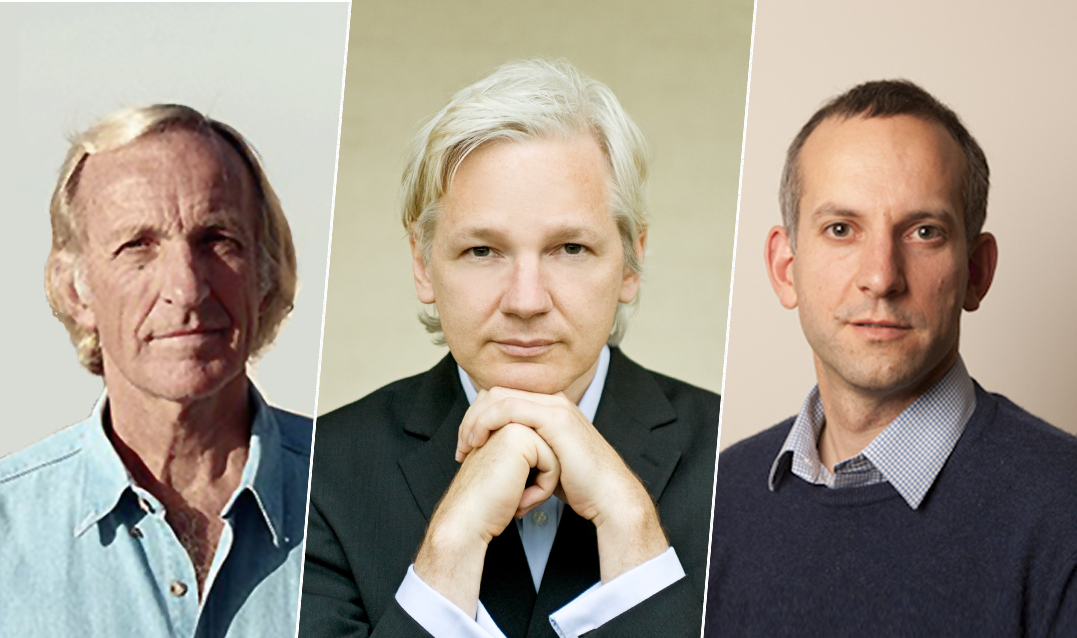
The Holberg team are preparing for what is expected to be a strikingly relevant Holberg Debate on 2 December, featuring prominent and even somewhat controversial media critics: John Pilger, Julian Assange and Jonathan Heawood.
Edit: Video can be found here: https://www.youtube.com/watch?v=LqEtKyuyngs
Is the World What Really What it Appears to be?
Call it propaganda, fake news, bias or distorted facts—manipulation of information may have vast implications for people trying to make sense of the world. While politicians and media actors accuse each other of undermining the truth and stirring up the public’s emotions with questionable assertions, it is often unclear whose interests lie behind the narratives and whether or not the news are truthful descriptions.
The central question we wish to pose for this year’s Holberg Debate is: Is there an escalating war of information that is threatening our democracy and our ability to make informed decisions? To discuss this and various other aspects of the presence of propaganda in news and social media, we will be joined by a panel of three prominent media personalities:
Panellists
Julian Assange joins the panel via videolink. Assange is an award-winning journalist and the founder and editor-in-chief of WikiLeaks. He is also a programmer, cryptographer, author and activist. Founded in 2006, WikiLeaks has published millions of leaked documents and several videos. This includes logs that relate to the wars in Iraq and Afghanistan, the controversial “Collateral Murder” video from Iraq, U.S. diplomatic cables, and election campaign related e-mails from the Democratic National Committee and from Hillary Clinton’s campaign manager, John Podesta.
Jonathan Heawood is the CEO and founder of IMPRESS, the only press regulator to be recognised as independent and effective under the Royal Charter in the United Kingdom. He has previously worked as a journalist and human rights campaigner, and he is a former director of English PEN. Heawood has written on free speech and regulation for various publications, including The Encyclopedia of Twentieth-Century Fiction, Critical Quarterly, Journal of Media Law, Ethical Space and Communications Law.
John Pilger is an Australian journalist, author and documentary film-maker. Pilger has covered military, political and cultural conflicts around the world for more than five decades, and his criticism of American, Australian and British foreign policy is strongly reflected his documentaries and writings. He worked at the Daily Mirror from 1963 to 1986 and wrote a regular column for the New Statesman magazine from 1991 to 2014. Pilger has won numerous awards as a journalist and film-maker, and he is one of only two people to win British journalism’s highest award twice.
The debate will be moderated by Professor Ellen Mortensen, University of Bergen. Ole Sandmo from the Holberg Prize Secretariat will interview Julian Assange during part of his appearance. In addition to keynotes from the panellists, there will be Q&A sessions where members of the audience will be welcome to ask questions.
Programme
| 3:00 p.m. | Opening remarks by Sigmund Grønmo, Chair of the Holberg Board. Introduction of the speakers by Ellen Mortensen, Academic Director, The Holberg Prize. |
| Part One | |
| 3:15 p.m. | Speech by Julian Assange. |
| 3:35 p.m. | Julian Assange is interviewed by Ole Sandmo of the Holberg Prize Secreariat. |
| 3:50 p.m. | Q & A with audience and panellists. Moderated by Ellen Mortensen. |
| Part Two | |
| 4:15 p.m. | Speech by Jonathan Heawood. |
| 4:35 p.m. | Speech by John Pilger. |
| 4:55 p.m. | Q & A with panellists and audience. Moderated by Ellen Mortensen. |
| 5:15 p.m. | End |
The event will take place on 2 December, 2017, 3:00 p.m. – 5:15 p.m., at the University Aula in Bergen. The debate will not be live-streamed. Admittance is free, but seating is limited.
The Holberg Debate 2017 is a collaboration between the Holberg Prize, the Fritt Ord Foundation and Norwegian PEN (Western Norway). We are also grateful to the Bergesen Foundation and the University of Bergen, whose support helped make this event possible.
For a longer introduction to the topic, see our Facebook event page or the Holberg Prize Calender.
Last edited:
Published:
Related content
“Everyone dreams at night”: Interview with Stephen Greenblatt
What are the paths and life events that have led 2016 Holberg Laureate Professor Stephen Greenblatt to where he is today? Where will he go from here? How will the humanities survive the current crisis? Those are some of the questions Greenblatt answers in this exclusive interview.
About Fredric R. Jameson
Fredric R. Jameson (born in 1934 in Cleveland, Ohio) is one of today's most important and most influential cultural theorists. He has done more for the contextual study of culture than any other living scholar. Over the past four decades, he has developed a richly nuanced theory of how modern culture – in particular, literature, painting, cinema, and architecture – relates to social and economic developments.

About Ian Hacking
Ian Hacking (born in 1936 in Vancouver, British Columbia) is one of the world's leading scholars in the fields of philosophy and history of science. He has made important contributions to areas as diverse as the philosophy and history of physics; the understanding of the concept of probability; the philosophy of language; and the philosophy and history of psychology and psychiatry.