

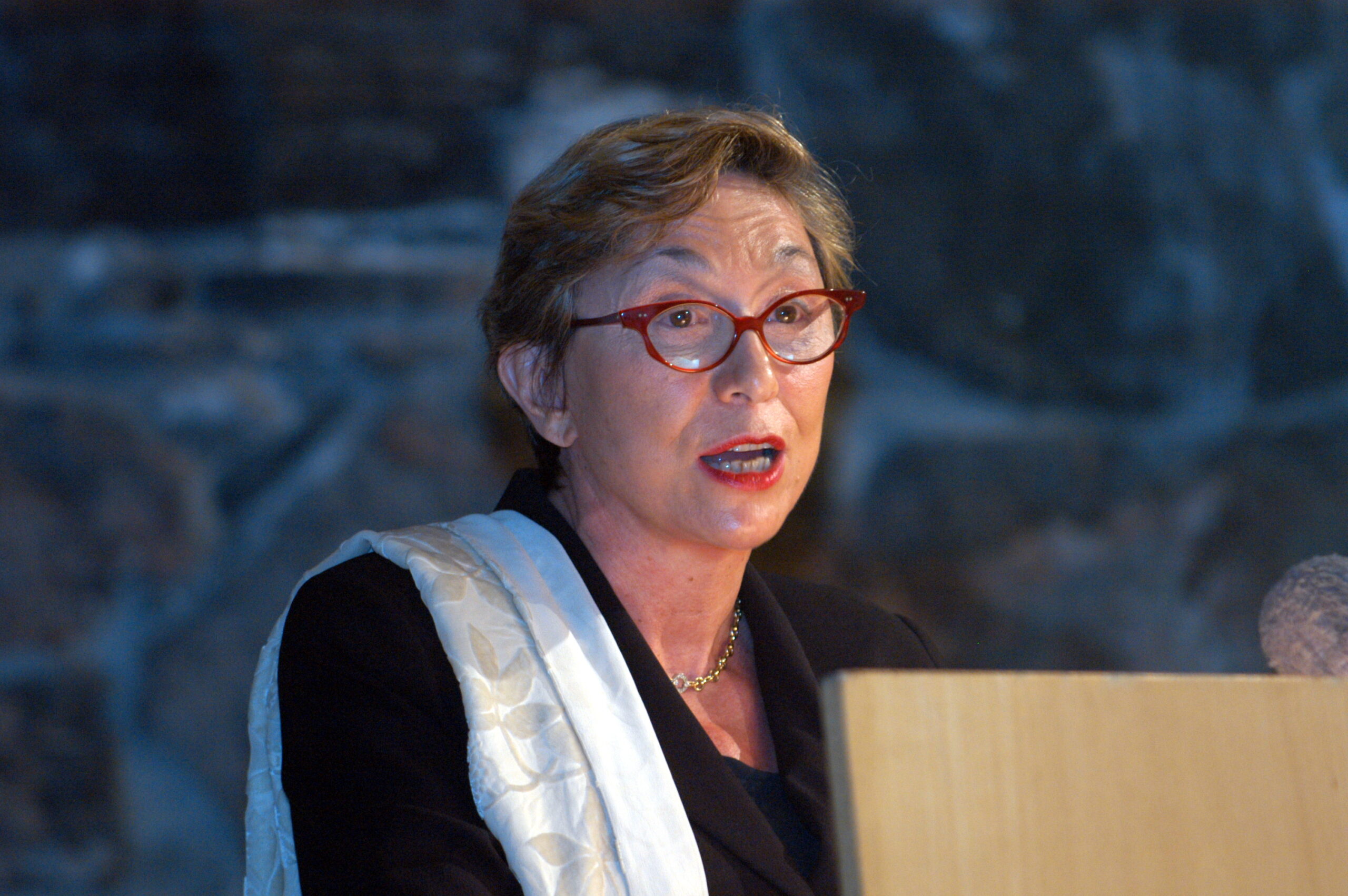
Julia Kristeva’s acceptance speech at the state banquet on 3 December 2004.
Julia Kristeva was awarded the 2004 Holberg Prize. Her acceptance speech from the state banquet on 3 December 2004 is published here in full.
Your Royal Highnesses, Your Excellencies, Ladies and Gentlemen
Your Royal Highnesses,Please allow me to express the sincere gratitude, and the emotion I feel on the occasion of my acceptance of the Holberg Prize, all the more so after your kind words. I would also like to express my thanks to the Norwegian Parliament which created this prize, as well as to the members of the jury who have bestowed this honour on me.
The Holberg Prize recognizes, in my person, a European citizen of French nationality, Bulgarian origins, and American by adoption. I like to think of my choice of this lifestyle, which I would happily call that of a nomad, as being in harmony with the spirit of Ludvig Holberg, the 18th century Danish-Norwegian writer, traveller and playwright, who was also a historian of political and religious life. I have no doubt that he would have agreed with Hans Christian Andersen, that other Scandinavian writer whose tales we loved so much in our childhood, that “to travel is to live”.
My own cosmopolitan destiny mirrors the evolution of European history since the Second World War; and in my work, I have indeed crossed the frontiers between disciplines, as the Holberg Prize jury has remarked.
In my native Bulgaria, situated at the crossroads of the Balkans, under the communist regime – and in spite of it – Byzantine spirituality combined with a cult of the Russian novel, German philosophy and the Enlightenment. It was there that my thought and my writing were initially formed. But it is in France, in the Encyclopaedist garden of French culture and language, that I have attempted to graft this thought. And accordingly, I would like to thank this country which has taken me in, this France which is never more French than when it is involved in self-questioning, sometimes to the extent of laughing about itself – with all the vitality that Holberg admired so much in Molière – which facilitates the task of creating ties with others. As I wrote in my book Strangers to Ourselves, this is what explains the fact that, as I see it, “nowhere is one more of a foreigner than in France, but nowhere is it better to be a foreigner”: the honour which I am here to receive today bears witness to this fact.
Several of those who have welcomed me and aided me in my life and in my thought come to mind on this occasion: my parents Kristine and Stoyan Kristev who repose in Bulgaria, Philippe Sollers who I married in Paris and our son David, but also my friends and collaborators at the CNRS, the Ecole des Hautes Etudes en Sciences Sociales, the Université de Paris 7 – Denis Diderot, the Institut Universitaire de France, the Société Psychanalytique de Paris. And I haven’t forgotten the publishers who have supported my work, after the journals Tel Quel and L’Infini, such as Seuil, Gallimard, and especially Fayard.10 11
I am however aware that it is primarily due to the publication of my entire body of work in English that I am here to receive this honour today; I would therefore like to take this occasion to thank
the American Universities which have supported my research, and to give special thanks to the Columbia University Press whose director of humanities is here with me today: in these times of “endless war”, it is important to show that the “Old Europe”, the “New Europe” and America are capable of working and thinking together.
I won’t go into more detail concerning my own intellectual career, nor will I attempt to summarise my books: I was invited to do this at a conference at the University of Bergen. I would only like to make three confessions, but don’t worry, they will be filtered through the writings of two great French writers, to whom I have devoted a great deal of my research.
First of all then, these words of Proust, “Ideas are substitutes for sorrows.” I hear these words resonating this evening, with my own story, as an exile and as a woman, but also with the civilisational conflict which our world is going through today. We may continue to wonder just how it is possible that these sorrows don’t lead us into melancholy and death, but towards the enigmatic life of the mind. This process is endless, and fortunately so.
My second quotation is from Colette. “To be reborn has never been beyond my powers.” This claim might appear over-pretentious, but is it not a specific capacity, which tends to be feminine, and which, rather than adaptation, prefers rebirth, renewal? If this is so, what conditions are required for such a renewal?
Finally, let me mention this motto of the heroine of my last novel, Murder in Byzantium, Stéphanie Delacour, “Je me voyage/I travel myself.” You can see that she expresses herself in neologisms, as Julia Kristeva did at the beginning of her career. And since this journalist is an educated woman, saying “I travel myself” is, in the end, her way of resuming a fundamental thread of our European culture: from Saint Augustine, who only recognized one native land, that of the traveller; as he put it “In via, in patria”, to Freud, who specified “There where it was, I will be.” In other words, for my heroine, as for myself, the crossing of frontiers – whether geographical, those between disciplines or modes of discourse – is only possible on the condition that the traveller is capable of calling into question their own internal frontiers: “I travel myself.” It is only on this condition that ideas can be substituted for sorrows, and rebirth and renewal become possible.
You can see that the key to my nomadism, and my questioning of established forms of knowledge, is none other than psychoanalysis itself, understood as a journey in which the psychic identity itself is reconstituted. So I am very happy to observe that the creators of the Holberg Prize, in referring to the human and social sciences, made particular mention of Freud’s great discovery.
I must, before finishing, say a word about Ludvig Holberg (1684-1754). This “Nordic Molière”, who was a reader of Voltaire and of Montesquieu, was a moderate man, but was radical in his way, and scathing about all kinds of excessive enthusiasm. He preferred laughter to religious fanaticism, writing several comedies, as well as a History of the Kingdom of Denmark and of Norway, a History of Religion, a History of the Jews, a History of Women (indeed, he is considered as “the first Scandinavian feminist”). This constant movement between genres and between disciplines nevertheless attained its polyphonic, intertextual unity, the sort of unity which is brought about by the conductor of an orchestra, only in his works of fiction. How could I fail to identify with such a figure! His philosophical novel, Niels Klim’s Subterranean Journey, mixes political satire and utopianism in such a way that the satire dissolves into the fantasy, and the facetious remarks triumph over the moral message. The result is that, today, we read this novel as a defence of the purely imaginary. As Holberg himself wrote in his Memoirs, “There’s no doubt that this work is trivial, but that does not mean that it is useless; for this is the only way that such teachings may work their way into the minds of many readers who are repulsed by formal treaties; as that ancient hero who had his epitaph inscribed on a sundial so that all who consulted it were able to read it, a joke can be a way of educating oneself whilst having fun. The fisherman must bait his hook in accordance with the taste of the smaller fish, if he wishes to catch them; in the same way, the greatest philosophers of the greatest music have, from time to time, known just how to help get the message across with the help of amusing stories.”
Although Baron Holberg described himself as an ascetic, and something of a hypochondriac, whilst managing to remain a comical figure, the first to acknowledge his importance after his death was none other than the libertine philosopher Giovanni Giacomo Casanova, in the Preface to his own subterranean utopia, The Icosameron of 1788. He writes: “Plato, Erasmus, the Chancellor Bacon, Thomas More, Campanella and Niels Klim are those who have given me the desire to write this story, or this novel”.
More than two centuries later, I would like to thank Ludvig Holberg for having given the jury which takes his name the desire to bring us together this evening. Thank you for your patience and for your warm welcome. And may I thank His Royal Highness, Crown Prince Haakon, and the Norwegian parliament for this high distinction with which I have been honoured.
Last edited:
Published:
Julia Kristeva
Julia Kristeva (f. 1941) is currently director of the Sciences des textes et documents Department at the University of Paris 7 (Jussieu), and is also a practising psychoanalyst.
Related content

The 2014 Anniversary Lectures: Julia Kristeva: ‘New Forms of Revolt’
What is revolt, and how does it set its mark on society? How does it feel? Could ‘revolt’, called ‘riot’…
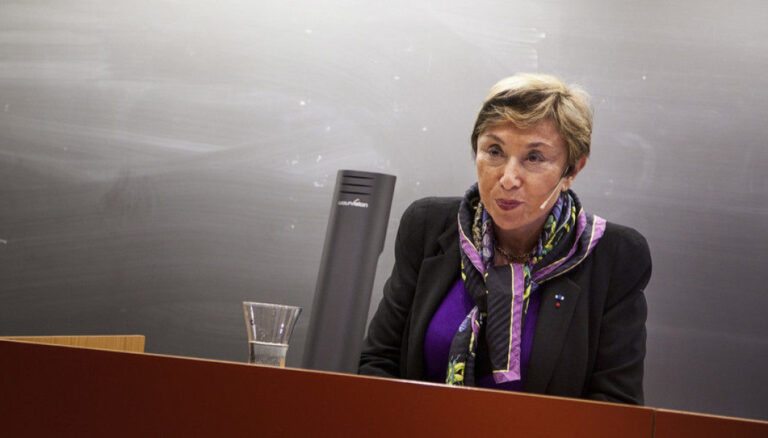
Julia Kristeva appointed the highest order in France
The French President François Hollande appointed Julia Kristeva to Commander of the French Legion of Honour ("commandeur de la Légion d’honneur) 21st December 2014.
The 2004 Holberg Lecture by Julia Kristeva
The lecture "Thinking about liberty in dark times” was presented by the 2004 Holberg Laureate, Julia Kristeva, at the Holberg Symposium, 2 December 2004.