

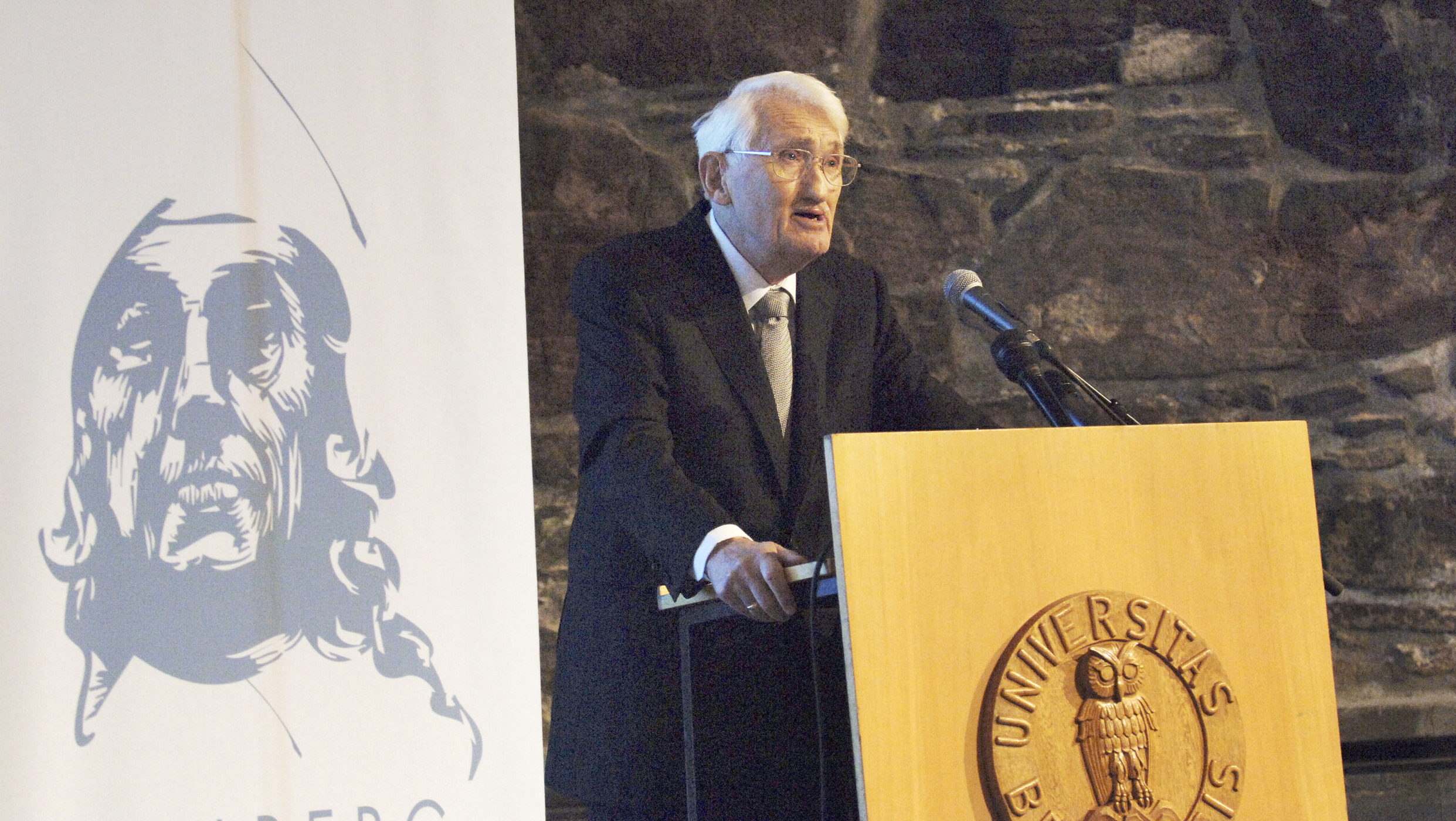
The Holberg Prize was conferred upon Jürgen Habermas on 30 November, 2005. The acceptance speech he held at the award ceremony is published here in full.
Jürgen Habermas’ acceptance speech
Minister Djupedal, Your Excellences, Representatives from the Ludvig Holberg Memorial Fund, ladies and gentlemen.
Not that I would not have any experience with the rare situation of being awarded with a prominent academic price. But the rank, the ambition and the excellence of this award is truly embarrassing for anybody who is very well of the fact that he is only one among many candidates of at least equal standing. I gratefully accept this distinction also as an expression of recognition of a whole generation of German philosophers who, after the end of World War II, entered the university and faced the challenge to renew the reputation and strength of a tradition the moral backbone of which hat been broken during the recent past. Of great support was the unbiased reception we enjoyed from colleagues in countries like Norway – including those who would have had good reasons for stronger reservations. I have still vivid memories of my first encounters with Knut Erik Tranøy and his younger colleagues, when Hans Skjervheim invited me, in the early 70s, to come to Bergen.
There are further reasons, why I am happy to enjoy the privilege of this occasion. It is a pleasure to serve the purpose of the Holberg Prize by helping to pull the paled face of the humanities out of the shadow of those more fortunate disciplines that are used to attract more public attention and more financial support for their more visible and robust achievements. I appreciate the decision of the Norwegian government to give, with this foundation, for the right purpose the right sign at the right moment. Moreover, it could have hardly chosen a more convenient patron for this institution than the unconventional founding father of modern Norwegian scholarship, Ludvig Holberg – an outstanding figure of the European enlightenment.
Far from the awkward role of a dignified and somewhat pompous professor, Holberg was a witty person and polemical writer, gifted with a broad range of talents, widely traveled, well versed in many languages and the ways of the world, a public figure, involved in quite a few controversies and, as the author of so many theater plays, well known to larger audiences in various countries. You imagine my increasing pleasure while reading the autobiographical letters – the epistolae ad virum perillustrem, which were, by the way, immediately translated from Latin into German, only two years after its original publication. I cannot but mentioning one episode that aroused my enthusiasm about Holberg in his role as a philosopher and let me discovered a brother in the spirit of post-metaphysical thought.
Describing the course of his life until the age of 33 years, Holberg in those letters continues to sing the melody of graceful laments about his desperate financial situation and his delicate physical constitution. But finally, the Danish King liberates him from this deplorable state by an appointment to the position of a veritable professor of metaphysics. Holberg comments the happy turn in his life with self-irony: “I received the office to teach metaphysics although that was against my inclination. This is why those people, who knew me better, predicted the decline of this splendid discipline. And they were not mistaken. I honestly confess that metaphysics was never in greater danger as under my tutelage.” Referring to his inaugural lecture, Holberg adds that all true admirers of metaphysics could not listen to him without anger since they must have had the impression of attending not an eulogy but “a funeral address on the occasion of the death of metaphysics”. This very phrase was unheard of in those days. That happened in 1717, seven years before Kant – the “Zermalmer” or great destroyer of metaphysics, as he was called – was even born. The intrepid Holberg, I guess, was an early forerunner of this first post-metaphysical thinker when he pronounced the death of the kind of rationalist metaphysics that remained the academic philosophy for almost the whole of that century.
The sympathy I have with the creativity and spontaneity of this independent and fearless mind is the same feeling which is aroused again and again by the civil mentality I encounter when I come to this country and meet my distinguished Norwegian colleagues. In this respect the lasting influence of Holberg has obviously shaped the spirit of the academic community in his homeland until to-day. I am grateful for what I benefited from rich intellectual contacts with a whole generation of students and academic grandchildren of Arne Næss, and from the vivid debates between those parties who leaned more to Wittgensteinian arguments on one side, or more to those of my friend Karl-Otto Apel on the other. My thanks for the jury’s decision is equally an expression of my gratitude for what I learned from these exchanges.
Professor Jürgen Habermas
Last edited:
Published:
Jürgen Habermas
Jürgen Habermas (1929–2026) belongs to those contemporary Master Thinkers who cannot be unequivocally located within the customary division of academic disciplines. His works cover a broad field of human and social sciences: philosophy, ethics, social theory and sociology, political theory, law and legal theory. In addition, he has actively participated in German and, especially since the 1990s, European debates on issues which he himself defines as ethico-political.
Related content

The 2014 Anniversary Lectures: Jürgen Habermas on ‘Democracy in Europe’
This lecture by Jürgen Habermas was recorded at the University of Stavanger, on 11 September, 2014 as part of the…
The 2005 Holberg Symposium: “Religion in the Public Sphere”
The main lecture at the Symposium “Religion in the Public Sphere” was held by the Holberg Laureate 2005, Professor Jürgen…
Jürgen Habermas
The Holberg Prize 2005 was awarded to the German philosopher and sociologist Jürgen Habermas.