

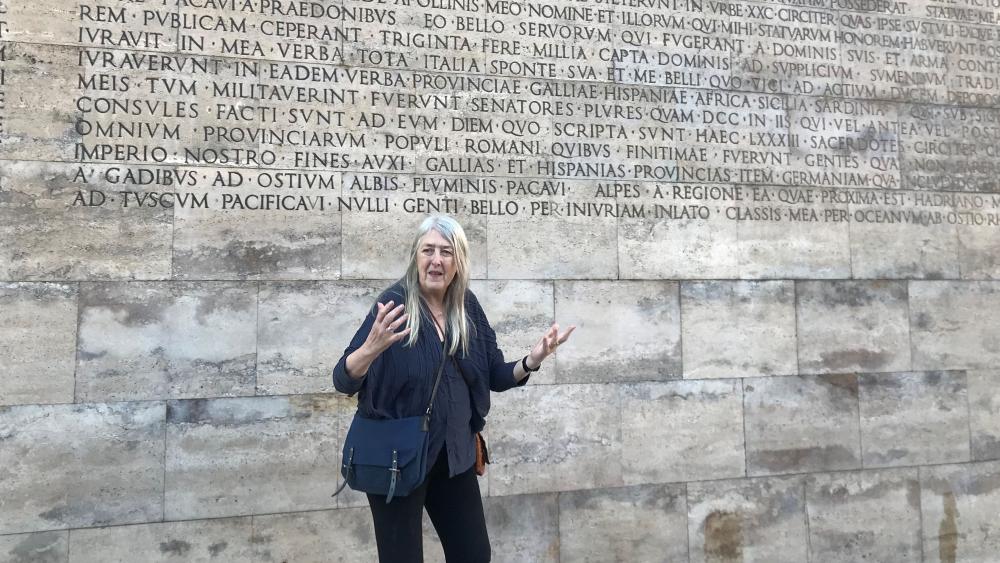
On 8 February, the Holberg Committee met in Rome, and Committee member Mary Beard delivered a lecture at the Royal Norwegian Embassy.
Dame Hazel Genn chaired the 8 February Holberg Committe meeting in Rome, where the five Committee members met to discuss this year’s shortlist of candidates for the Holberg Prize and recommend a recipient. The Committee was unanimous in its decision, and its recommendation was put forward to the Holberg Board. The Board convened on 12 February made their decision on the 2019 recipients of the Holberg Prize and Nils Klim Prize, respectively.
A total of 82 nominations for 79 candidates were received for the 2019 Prize, and of these, six were on the shortlist. Most of the 79 candidates were primarily affiliated with US institutions, with the United Kingdom coming in second. Although most candidates’ primary affiliation was to American or European institutions, many of them also hold positions at institutions in other parts of the world.
The decision on this year’s Laureates will be announced on 14 March, at 09:00 AM, at Media City Bergen. You can watch the livestream at holbergprize.com.
What’s the Point of Ancient Rome?
In connection with the Holberg Committee meeting, there was also an event at the Royal Norwegian Embassy the previous evening. After introductions by Ambassador Margit F. Tveiten and Chair of the Holberg Board Sigmund Grønmo, as well as by Academic Director Ellen Mortensen, Committee member Mary Beard delivered a lecture entitled “What’s the Point of Ancient Rome?”
Beard is Professor of Classics at the University of Cambridge, a fellow of Newnham College, and Royal Academy of Arts Professor of Ancient Literature. She is also the Classics editor of the Times Literary Supplement, where she also writes a regular blog, “A Don’s Life”.
“The commonest question I get from journalist,” said Beard, “is: ‘Which Roman emperor is Donald Trump most like?” It is a rather silly question, Beard thinks, and a poor comparison. “I usually tell them the name of an emperor they haven’t heard of.”
Ancient Rome is not only Toxic Rome
It is a widely held opinion that we know nothing or very little about many aspects of Ancient Rome. Beard stressed that we can bemoan what the Romans do not tell us about, but then we are probably asking the wrong questions: «There is more surviving Roman literature than what anyone could master in a lifetime,» she said. «This is a richly documented community.»
Beard also underscored how the West over the last couple of centuries have used the connection to Ancient Rome to justify imperialism, elitism and exclusion. “But,” she suggests, “it seems to me that this is only one side of the story.”
“To stress the toxicity of the ancient world and its influence on the modern world,” says Beard, “is actually to miss out on some much more important points on what engaging with Ancient Rome can bring to modern debates.”
Beard explains how Ancient Rome to her has become a beacon for enjoying things being complicated, rather than an image that serves to simplify explanations. Thus, we do not study Ancient Rome to find out which emperor Donald Trump resembles the most. Rather, Beard says, “We study Rome, in part, to see ourselves from a different point of view.”
Video of the lecture is available here:
Audio is available here:
Last edited:
Published:
Related content

“Everyone dreams at night”: Interview with Stephen Greenblatt
What are the paths and life events that have led 2016 Holberg Laureate Professor Stephen Greenblatt to where he is today? Where will he go from here? How will the humanities survive the current crisis? Those are some of the questions Greenblatt answers in this exclusive interview.
About Fredric R. Jameson
Fredric R. Jameson (born in 1934 in Cleveland, Ohio) is one of today's most important and most influential cultural theorists. He has done more for the contextual study of culture than any other living scholar. Over the past four decades, he has developed a richly nuanced theory of how modern culture – in particular, literature, painting, cinema, and architecture – relates to social and economic developments.

About Ian Hacking
Ian Hacking (born in 1936 in Vancouver, British Columbia) is one of the world's leading scholars in the fields of philosophy and history of science. He has made important contributions to areas as diverse as the philosophy and history of physics; the understanding of the concept of probability; the philosophy of language; and the philosophy and history of psychology and psychiatry.