

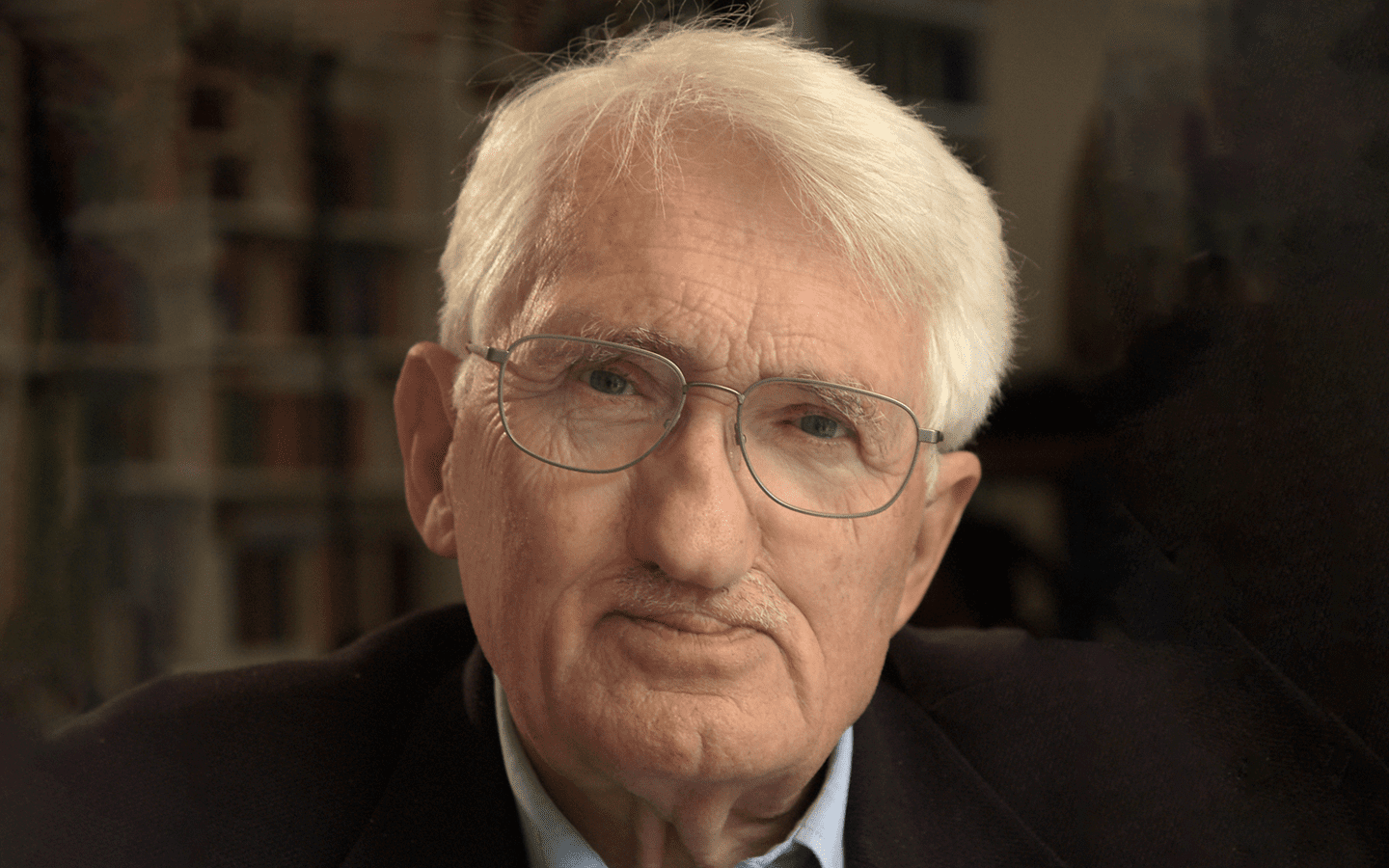
We are saddened by the passing of 2005 Holberg Laureate Jürgen Habermas on 14 March 2026.
Born in 1929, Friedrich Ernst Jürgen Habermas was one of the most well-known and influential philosophers of his generation. He has fundamentally shaped thinking and scholarship on communication and democratic practices through a life-time of academic work and public engagement. Initially deeply intellectually shaped by the framework of the Frankfurter school, including his predecessors Max Horkheimer, Theodor Adorno and Herbert Marcuse, Habermas developed his own particular modernist approach to critical thought, particularly emphasizing rational communication. His work thereby posed alternatives to postmodernist critiques of discourse and, also, less optimistic readings of democratic possibilities, including those suggested by others in the Frankfurter school. Habermas is often referred to as providing a more hopeful framework for political communication and democracy than other philosophers and political thinkers of his generation.
Starting in 1956 at the Institute for Social Research (Institut für Sozialforschung) at what is now Johann Wolfgang Goethe-Universität Framfurt am Main, Habermas thereafter held various positions in Bonn, Marburg and Heidelberg. He returned to Frankfurt in 1964, taking over as Chair of Philosophy and Sociology, succeeding Max Horkheimer. Thereafter, from 1971 to 1981, he assumed the position of director of the Max Planck Institute in Starnberg. From 1983 until he retired in 1994, he held a professorship in philosophy and history of philosophy, teaching at Johann Wolfgang Goethe-Universität Framfurt am Main.
Ronald Dworkin, also a Holberg Prize Laureate, commented on Jürgen Habermas when he turned 80 that “Jürgen Habermas is not only the world’s most famous living philosopher. Even his fame is famous”.
Habermas was conferred the Holberg Prize in a formal ceremony on 30 November 2005 in Bergen. At the Holberg Symposium the previous day, he gave his Holberg Lecture on the theme “Religion in the Public Sphere” which can be read in full here. He was thereafter engaged in discussion by a host of other scholars. On occasion of the ten-year anniversary of the Holberg Prize in 2014, Jürgen Habermas gave the lecture “Democracy in Europe” at the University of Stavanger, at an event organized by the Holberg Prize. A video recording of this event is available here.
The Holberg Committee’s recommendation for awarding Jürgen Habermas the 2005 Holberg Prize is reproduced here in extenso:
Jürgen Habermas has developed path-breaking theories of discourse and communicative action and thereby provided new perspectives on law and democracy. His research is thematically wide ranging and has had exceptional interdisciplinary impact. Habermas has significantly contributed to the understanding of rationality, ethics, legitimation, critical public discussion, modernity, the post-national society and European integration.
His intellectual breakthrough was The Structural Transformation of the Public Sphere (1962; Eng. ed. 1989), which, by combining empirical and theoretical research from a number of disciplines, constituted an original contribution to democratic theory. In his opus magnum The Theory of Communicative Action (1981; Eng. ed. 1984/87) he provides a new foundation for critical social theory and discusses the possibility of public discourse among free and equal citizens. The discourse theory of law and deliberative democracy is outlined in Between Facts and Norms (1992; Eng. ed. 1996). His conception of democracy is further elaborated in articles addressing contemporary issues such as the multicultural society, nationalism and globalization (collected in The Inclusion of the Other (1996; Eng. ed. 1998) and The Postnational Constellation (1998; Eng. ed. 2001). Lately, Habermas has among other things worked on foundational problems in ethics and philosophy. Jürgen Habermas has had extraordinary international influence in a great number of disciplines.
Habermas has significantly influenced major debates on the public sphere, right-wing discourses and historical revisionism in the whole post-war era. Since being awarded the Holberg Prize in 2005, Habermas continued to publish, to actively contribute to public debate and to write—impressively also dealing with social media and its impact on public discourses and possibilities for communication in later years. His last book-length publication, entitled Things Needed to Get Better” Conversations with Stefan Müller-Doohm and Roman Yos (Polity Press, 2025—German original 2024), aptly reflects the normative tenor of his work and scholarship. In this book, he states: “I view the attempt to make the world even the tiniest bit better, or even just to be part of the effort to stave off the constant threats of regression that we face, as an utterly admirable motive.”
Last edited:
Published:
Related content
The 2005 Holberg Symposium: “Religion in the Public Sphere”
The main lecture at the Symposium “Religion in the Public Sphere” was held by the Holberg Laureate 2005, Professor Jürgen…
The Holberg Anniversary Lectures 2014
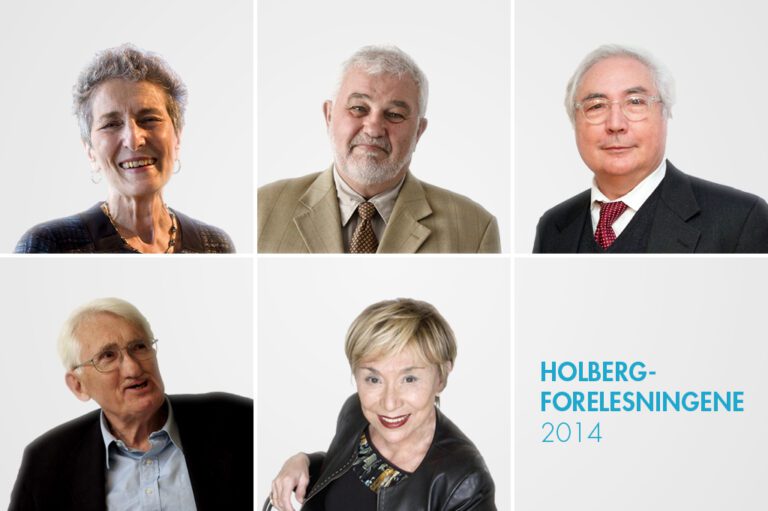
The Holberg Lectures presents a general audience in Norway with a unique opportunity to listen to world-leading academics, all previous…
Jürgen Habermas
The Holberg Prize 2005 was awarded to the German philosopher and sociologist Jürgen Habermas.