

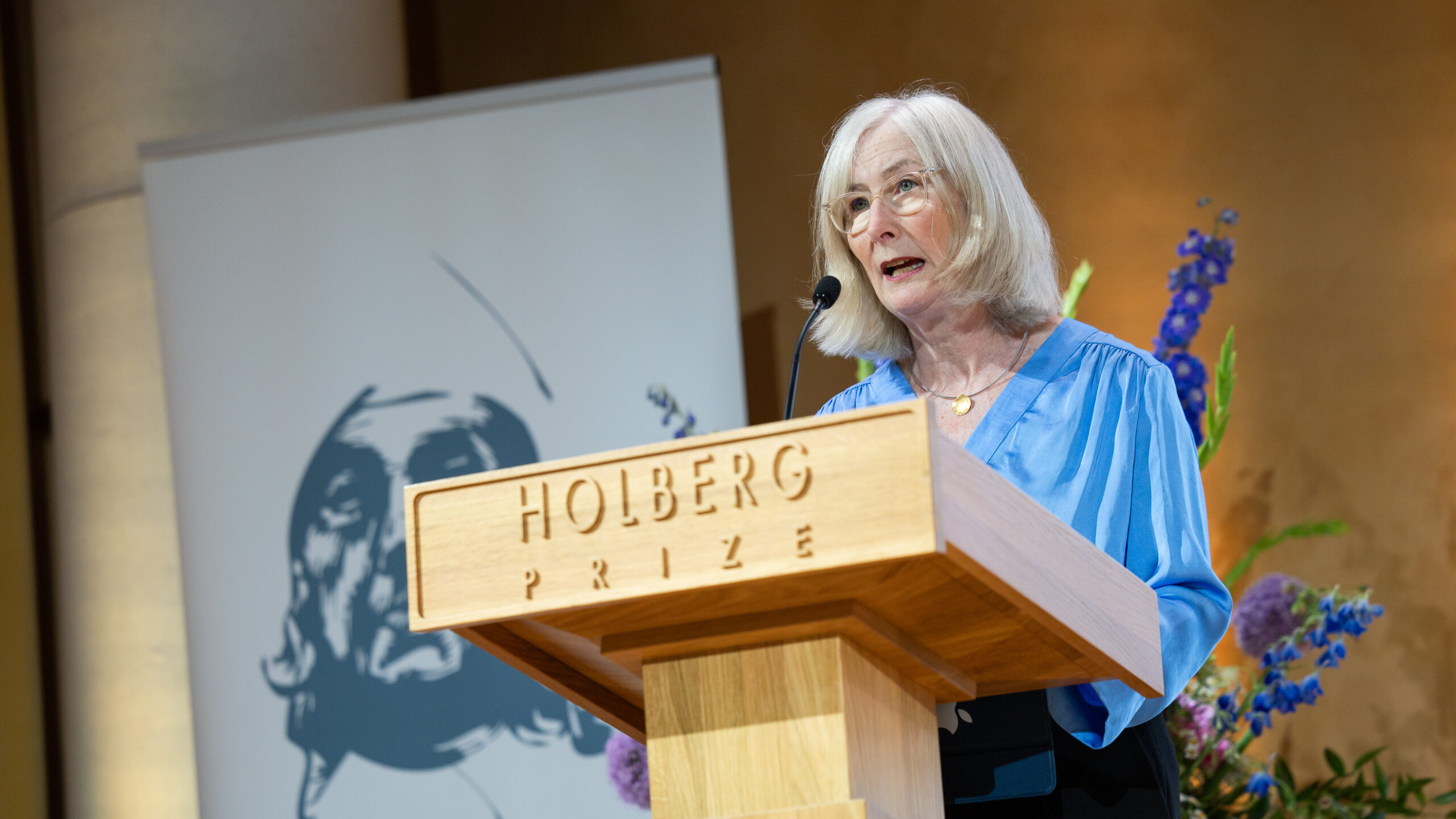
The Holberg Prize was conferred upon Lyndal Roper on 4th June, 2026. Her acceptance speech is published here in full.
Minister of Research and Higher Education Sigrun Aasland, Mayor Marit Warncke, Madam Rector, Nils Klim Prize Laureate Majse Lind, distinguished members of the Holberg Committee and the Holberg Board, family, friends, and colleagues.
The Holberg Prize means so much to me because, as it happens, I’ve read the work of nearly all the previous winners, and they have been among the people whose work inspired me most. As a postgraduate in London, I heard Marina Warner give a fabulous open-ended paper on Joan of Arc, honest about all Joan’s contradictions. It showed me how a historian could set out their perplexity, and how sources can point in different directions. Paul Gilroy spoke inspiringly at my college, to move things on from its legacy of Cecil Rhodes and imperialism. I miss Natalie Zemon Davis more than I can say. She showed what women’s and gender history could be, and throughout her life she was always moving ahead, with her wide sympathy for people of all cultures and religions. And I wish that Rebekka Habermas, Jürgen Habermas’s daughter, could be here, because she welcomed me, gave me her friendship; and did so much to change what history could be in Germany and who could write it. She died far too soon.
The Holberg Board has chosen the people who have been original, path-breaking, who have changed how we think, and they have also chosen people whose work was based on values and commitment, whom I’ve always admired personally. That’s why I’m overwhelmed by this award, which I think recognizes the work of an entire generation of historians, philosophers and thinkers of many disciplines who have rewritten the history of women, sex and gender and taken it in so many different directions. And you have seen this week where they will take it, and how they are responding to the challenges we face today.
The second reason the award means so much to me is Holberg himself. One of its great pleasures has been reading Ludvig Holberg, whom I confess that to my shame I hadn’t known before, a wonderful Enlightenment Danish-Norwegian figure. And he is also a historian, one of the first to write about women. He does not exactly pick up where Christina de Pisan left off, because he is not providing a set of exemplars of ‘good women’. Instead like Plutarch he provides a serious examination of pairs of female rulers, to point up their strengths. Never reducing female governors to ‘characters’, he shows them as political actors, and so when, for instance, he discusses Elizabeth I, he explains the international situation she faced and the reasons she executed Mary Stuart, without ever stooping to misogynist cliche. He takes women seriously as political actors, and with it, stakes a claim for female equality by simply assuming that women can rule.
But even more, he is a fantastic playwright. He has the anthropologist’s eye – he notices the ubiquitous tobacco and tobacco pipes, he mocks the poor noblewoman who cannot stand the ‘bourgeois smell’ of her hostess’s house and suggests she fumigate it. He relentlessly pokes fun at the pettiness of class and the pretensions of the cultured – who can forget the printer’s wife, who congratulates the new mother on her ‘first edition’,- ‘always the worst’ – and condescendingly explains the difference between folio and quarto. But he is never nasty, as he says, he never ‘aims at anyone’ and his jokes are good-humoured, while his plays always strive to restore concord and amity amongst all. He is a man of the Enlightenment, a townie who has left the world of the sixteenth and seventeenth centuries behind, with its cruelties and belief in witchcraft, who stands on the threshold of a new one. He is in a sense a dramatist of kindness, a value that seems ever more important now.
So, in tribute to Holberg I wanted to imagine three characters who stand in the shadows of his play The Lying-in-Room – “Barselstuen” – from 1724. Holberg’s subject is the first six weeks after birth before churching, when the new mother is visited by everyone and there is feasting and dancing. First let me imagine the woman who doesn’t appear but who is implied when Holberg’s characters joke about the babies who arrive though everyone knows their fathers were in the East Indies 40 weeks before. But what if we turned this around, and thought about the women in the East Indies, pregnant by these same men, for which this is surely a cover? What happened to them, what were their lyings-in like, and how did they raise their children with or without help from those children’s fathers? What about the children who were mixtures, both Danish-Norwegian and Indian or even African? The hero of the play is a 70 year old new father, who worries that his wife’s music master, the Cantor, has cuckolded him. But – what if the Cantor were a castrato, as he probably was, and what kind of deeper level of joke is implied here? How was he played and with what register of voice? Within the orderly Lutheran household, a wonderful world of sexual ambiguity opens up. Corsitz the husband is no patriarch but a figure of fun, grumbling as he grinds six pounds of coffee for the new mother’s 93 female visitors and fuming about this ‘Turkish’ luxury, a classic example of the international trade that was changing that eighteenth century world. Comfortably off, socially secure and a new father, his opposite is a minor figure in the cast, the old woman who speaks blessings and who is twitted as an ‘old witch’. What does the lying-in room look like from her point of view? Just a hundred years before, the lying-in-maid, usually an older woman, might be the target of witchcraft accusations. The only sane character in the play is the healthy new mother, immune to any fears of witchcraft, whose palpitations are caused by the doctor’s medicine, not by any weakness after giving birth.
All these characters are there in Holberg and we need all their voices in the history we write. And what Holberg chronicles is a massive change in social history, as international trade meant that Norway was part of a much wider world. And where, too, the witch gradually ceased to be a figure of fear and was banished to the nursery and to fairytale – and as the lying-in period gradually withered away as women were thought not to need it. But like much historical change, the end of childbed had its down sides too – bad luck, if you were not as strong of body and mind as Holberg’s rosy-cheeked heroine. We live with the legacies of Holberg’s blithe assumption that new mothers have no need of cossetting, or even, one might now say, of maternity leave.
The third reason why the Holberg Prize means so much is that it is a loud, international affirmation of the value of humanities. And this is especially important now, at a time when students are told to choose other subjects, when in my country humanities departments face closure and where there seems no academic future for those who finish doctorates in the arts, when the advance of AI leads people to say that we no longer need history because Chat GPT can provide a synthesis of anything, or that good writing does not matter because Deep L can improve your style or indeed write passably in any language you choose. Or that international law is outdated, or historical thinking about difficult issues just an irrelevance, when everyone’s attention-span these days is so much shorter.
This is where the Holberg Prize is so important, because it insists on the value of the humanities and of the human. After all, even if robots can outrun humans (that is, when they don’t fall over), AI doesn’t have a body, not one of flesh and blood physiology. AI can summarise articles or produce syntheses; but it cannot give us critical thought or originality, or tell us more about being human.
One reason why this is so, is because human beings are embodied. They move in space, they have what I’d call a psyche, or perhaps we might say an unconscious, what Sigmund Freud called a Seele, or soul. They think, feel, speak and they move, and their actions are not the result of rationalisations but of a whole mixture of emotions, or what David Hume called the passions. People relate to one another emotionally and in space and time. Different cultures and religions, of course, would conceptualise this differently, and one of the historian’s tasks is to elucidate this as richly as possible. But for my part, it has been important to write history that reflects three things about human beings: first, that people are embodied, second, that they have subjectivities, by which I mean their conscious and unconscious perceptions of the world around them, and third, that they move in a landscape. I’ve been able to do that because since the Second World War, women have entered the humanities in great numbers and they have changed the kinds of question it’s possible to ask.
We need the humanities because we need to be able to assess the ‘answers’ AI seems to offer. We need to be able to interrogate the relationship between evidence and argument, and that is what not only history but all the humanities do. And we need ideas that do not already exist in the vast soup of pre-existing knowledge; we need creativity and originality; indeed, I’m hopeful that AI will mean we learn to value neurodivergence more. [BB3] The humanities challenge us to think about societies as a whole and the structures of power in which we live, and to think in the long term, with a sense of context and of the past, not just about what grabs soundbites today. Humanities explore what tools we use to analyse societies, and how to change those structures; how, that is, to imagine a different future.
Holberg himself brought all this together: he was a dramatist as well as a historian, an anthropologist as well as a novelist, a creator even of his own kind of science fiction. As a historian, I’ve tried to create as full a picture as possible, to include as many voices as I can, and to write about all dimensions of human existence, dreams, revolutions where vast numbers of people march together, and humans’ relationship to the landscape. One reason why I was drawn to Martin Luther was because he does not make the radical distinction between flesh and spirit that most Christian thinkers do. This is why it was so important to him to insist that Christ was REALLY present in the bread and wine of communion, and it is also one reason why he remains a theologian worth engaging with, and – despite the famously dreadful things he said about women – who can be useful for women, who usually do badly whenever the flesh is denigrated.
Over my career, I guess I’ve been part of a movement that is sometimes called ‘history from below’. I have wanted a history that isn’t just that of great men, Kings, and battles, and that doesn’t use abstractions like ‘the Reformation’, ‘imperialism’, ‘the household’ without taking them to bits. I started history reading my granddad’s dreadful British imperial history books that glorified the conquest of India –I still have an old photo of me sitting with him and my brother and sister outside his sleepout where they were on the shelves – and yet I knew that as a cantankerous Aussie First World War soldier he had a visceral hatred of the British ruling class. Thank goodness those are no longer the books that are on shelves today, and certainly not in Australia.
Above all, I have wanted the experience of women to be part of the humanities. And here I owe so much to others, to the London Feminist History group, to History Workshop, and to my friends, especially to Ruth Harris, historian of France and India, who can’t be here tonight, and to my husband Martin Donnelly. When I got my first job, I was the only woman in an Oxford Senior Common Room alongside 60 men; when I first went to Germany, there were only three women professors of history. That world has gone, I hope for good, but we still have a long way to go to make our humanities departments more diverse, and to make intellectual conversations truly global.
At the end of A Doll’s House, that gripping Norwegian drama that I remember reading as an adolescent in the Australian summer, Henrik Ibsen’s Nora says she ‘must try and educate myself’ and that this is something she must do without her father or her husband, for herself. She refuses to be a doll any longer, and says to her husband ‘I believe that before all else I am a reasonable human being, just as you are – or, at all events, that I must try and become one’. Nora has to choose between becoming herself, and her children and husband. She cannot be a mother and be free. We still don’t have a world where women can easily have both, fulfilment and motherhood; but there is so much more we could do to make that happen, for men, and for women; for those with, and those without children, because all of us have a stake in the future, and even in these challenging times, there is so much to hope for and to do.
Last edited:
Published:
Lyndal Roper
Lyndal Roper is a historian of German history 1500 to1800, especially women and gender. She has written a biography of the reformer Martin Luther, and last year published Summer of Fire and Blood, a history of the German Peasants’ War: to write it, she walked or cycled just about all the areas affected by the War. She has taught at King’s College London, Royal Holloway, University of London, and the University of Oxford. In 2011 she became Regius Professor of History at Oxford, the first woman to hold the 300 year old post. She co-edited the journal Past & Present for over a decade and has been a member of History Workshop Journal Collective for forty years. Now she runs experimental workshops, ‘Moving History’, teaching critical and creative thinking in combination with (light!) physical exercise.
Related content
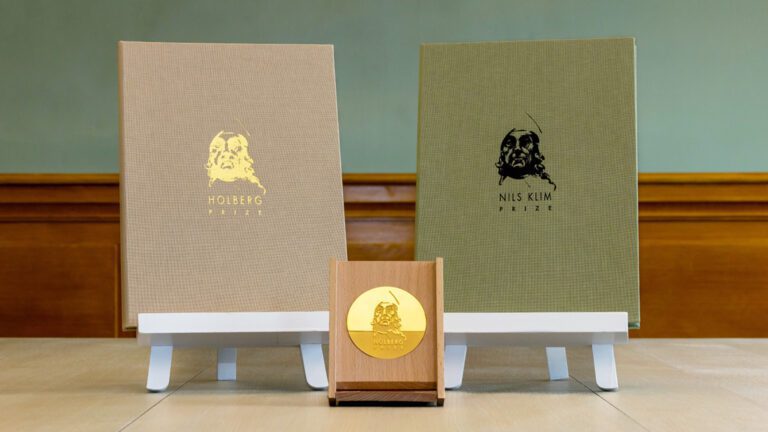
Award Ceremony for the 2026 Holberg Prize and the Nils Klim Prize
The 2026 Holberg Prize is awarded to Lyndal Roper for her pioneering work on early modern European history. The 2026…

The 2026 Holberg Lecture: ‘Who Owns Fertility? The Reformation’s Sexual Politics’
Lecture by the 2026 Holberg Laureate Lyndal Roper.
Lyndal Roper
The 2026 Holberg Prize is awarded to Australian scholar Lyndal Roper for her pioneering work on early modern European history.