

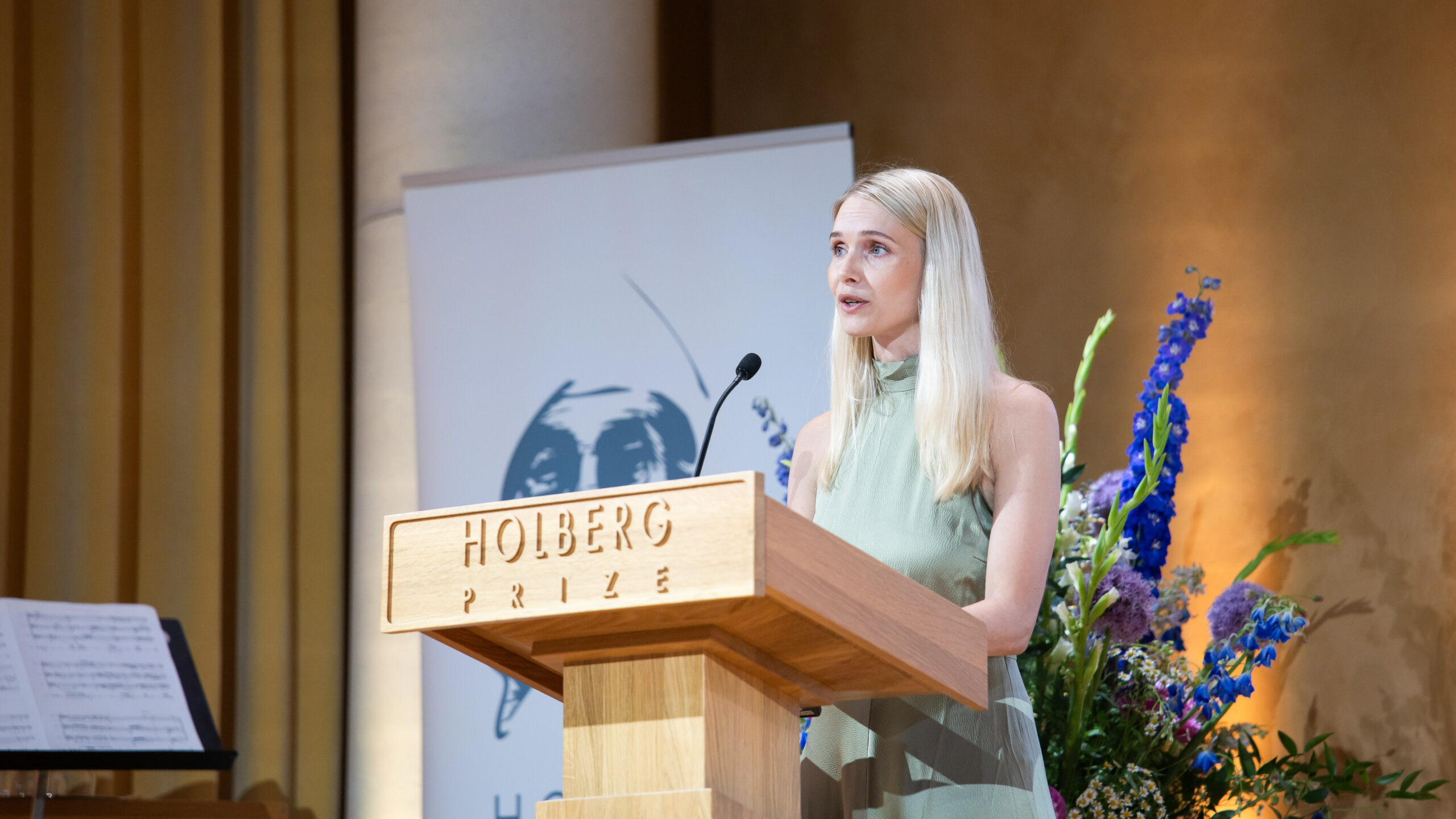
On 4th June, 2026, the Nils Klim Prize was conferred upon Majse Lind. Her acceptance speech is published here in full.
Minister of Research and Higher Education Sigrun Aasland, Representative of the Mayor, Madam Rector, Holberg Prize Laureate Lyndal Roper, distinguished members of the Nils Klim Committee and the Holberg Board, family, friends, and colleagues.
I am deeply honored and humbled to join the distinguished line of Nils Klim Laureates, whom I hold in the highest regard.
On behalf of my field, I am equally honored that narrative identity—our life stories—is being recognized in this important way. When Dan P. McAdams in the 1980s posed the fundamental question, “What do we know when we know a person?”, he moved beyond dispositional traits such as extraversion or neuroticism—those that describe patterns of behavior. He also went beyond goals and motives, and instead pointed to a deeper layer of personality: the life story. The layer that captures what makes each of us unique. The layer that speaks to what it means to be human.
We are, by nature, storytellers. We construct narratives of who we are to create a sense of coherence across time—linking our past, present, and imagined futures. In today’s world, research moves faster than ever, driven by big data, speed, and technological innovation. Yet narrative research asks us to do something different. It asks us to slow down. To listen. To let stories breathe—and to make sense of them.
But not all stories are given the space to breathe. Some are silenced, marginalized, or stigmatized because they do not fit dominant cultural expectations—the so-called master narratives. These narratives shape not only how a “good life” is defined, but also who has access to living it. People differ in their opportunities and resources to tell such stories—and to inhabit them.
At a time when the world faces a growing mental health crisis, this becomes particularly urgent. Increasing numbers of young people are struggling, especially young women. For many individuals living with mental illness, their stories do not align with dominant narratives of agency, coherence, or redemption. Instead, their narratives may be more fragmented, contamination, and marked by loss, alienation, and diminished mastery.
In my work, I am honored to let these, alternative, stories breathe and observe them be transformed in psychotherapy. To help individuals become authors of their own lives, rather than characters constrained by scripts written by others. These alternative stories matter. They expand what is possible. They challenge norms and power. And they create hope—often gradually, but meaningfully.
The Norwegian psychologist and author Arnhild Lauveng offers a powerful example. Diagnosed with severe mental illness and hospitalized for a decade, her life story was largely defined by others. Yet she held onto a different narrative—a vision of recovery and of becoming a psychologist. Against the odds, she realized that vision. Today, her story inspires many who seek alternative paths forward.
My own story, like many others, is shaped by both joy and hardship. It is the story of a curious young female protagonist who has traveled across countries for work, for love, and for adventure. Along the way, I have been fortunate to meet inspiring and generous people. I have also faced loss—at times intertwined with mental illness. These experiences, and the meanings I have made of them, have shaped who I am today.
I would like to express my deep gratitude to the narrative research community for being such a generous, intellectually vibrant, and supportive space. To my INDEPTH research group. To my close collaborator and dear friend, Lennart Kiel, who has traveled here with me.
To my soon-to-be husband, Kristian, and to my children, Felix and Alice—thank you for your love, patience, and joy. And to my parents, thank you for always supporting me and the path I have chosen.
I would also like to thank my former Head of Department, Mikael Vetner, for his trust in me, as well as the current Head of Department at Aalborg University for their continued support.
Finally, and most importantly, I want to thank all the participants who, over the years, have shared their stories with me. This recognition belongs, in many ways, to them.
Thank you.
Last edited:
Published:
Majse Lind
Majse Lind is Associate Professor of Psychology at Aalborg University in Denmark. She received her PhD from Aarhus University and has also held postdoctoral positions at Northeastern University and at the University of Florida, USA. Her research examines identity at the intersection of personality development and personality pathology, with a particular focus on narrative identity. Lind leads the IN:DEPTH Lab and is Co-Director of the AI:MIND Lab, where artificial intelligence is used to identify early markers of personality pathology. She is also President-Elect of the International Society for the Study of Personality Disorders (ISSPD), has received several awards for her work, and has published widely in leading international journals.
Related content

Majse Lind
The 2026 Nils Klim Prize is awarded to the Danish psychologist Majse Lind for her interdisciplinary research on mental health.
Award Ceremony for the 2026 Holberg Prize and the Nils Klim Prize
The 2026 Holberg Prize is awarded to Lyndal Roper for her pioneering work on early modern European history. The 2026…
The 2026 Nils Klim Symposium: ‘Storying the Person in a Mental Health Crisis’
The symposium is held in honour of the 2026 Nils Klim Laureate Majse Lind. The Laureate’s lecture is followed by presentations by…