

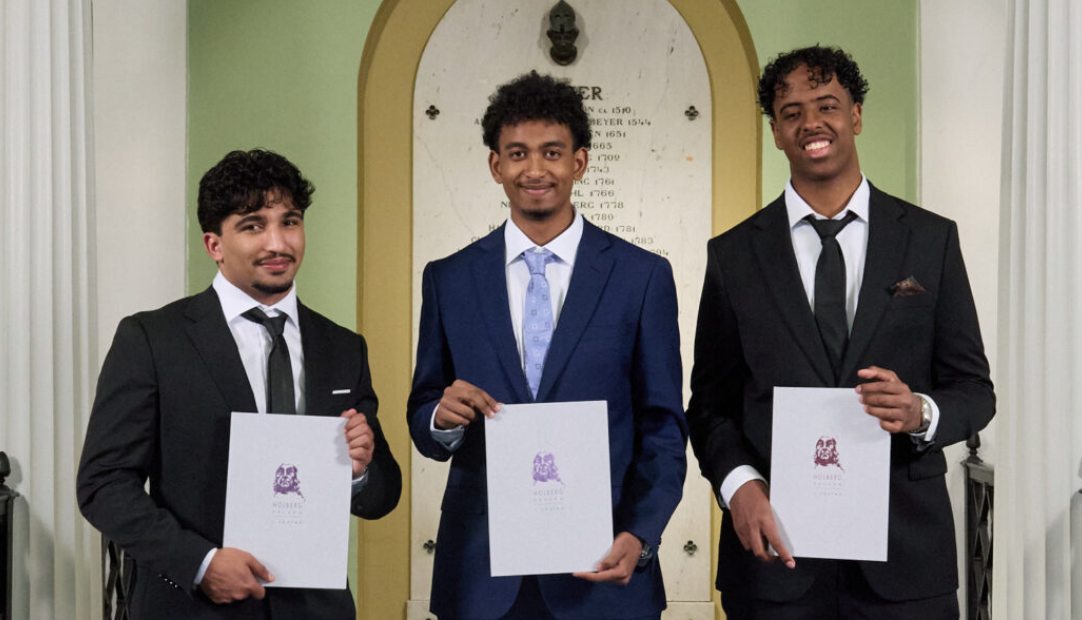
Abdikarim Fuaad Ali, Elnathan Shegaw Anagaw and Wakman Konarai from Drammen Upper Secondary School came in second place in 2026 for their project “It Costs Nothing. That’s Why it is Expensive”.
This project addresses the challenges associated with—and the consequences of—students’ use of artificial intelligence in their schoolwork.
Through in-depth interviews with students at an upper secondary school, the researchers examine the significance of these students’ use of AI for their learning outcomes and their sense of self-efficacy. They conclude that the technology itself is neutral, but that the context in which it is used is not. Approached with curiosity and academic confidence, the tool becomes a support in the learning process. When the student encounters it under stress, time pressure, and fear of failure, it becomes a substitute for learning.
The jury’s statement:
In the project “It Costs Nothing. That’s Why It’s Expensive,” Abdikarim Fuaad Ali, Elnathan Shegaw Anagaw, and Wakman Konarai examine how the use of AI affects upper secondary students’ learning and their belief in their own abilities. The study is based on qualitative in-depth interviews with students enrolled in the academic track. The researchers found that the issue was more complex than they had initially anticipated, and concluded that the use of AI represents a systemic problem rather than an individual student problem.
The report is very well written and captures the reader’s attention. In their literature review, the researchers not only outline what we already know, but also demonstrate an ability to build on existing literature by highlighting the issues it raises. In this way, they effectively underscore the importance of their own contribution.
They also show a high degree of sociological independence and creativity by introducing their own concept, “false success.” The methodology section is consistently strong and transparent, with the researchers demonstrating careful reflection on methodological challenges related to their topic and target group.
The analysis and conclusion are excellent. The researchers address their research question by interpreting their data in light of existing literature and theory, thereby demonstrating a strong ability to use theory for both explanatory and exploratory analysis. A key finding is that the target group engages in behaviour they themselves consider problematic—using AI despite knowing it leads to less learning—because the school system emphasizes and rewards final results. In this way, the researchers are able to abstract their findings to say something more general about human behaviour.
The jury congratulates Ali, Anagaw and Konarai on a very well-executed project, which also serves as an exemplary model for future young researchers!
The Research Project
Title:
Written by:
Abdikarim Fuaad Ali, Elnathan Shegaw Anagaw and Wakman Konarai
Year:
About the School Programme

The Holberg School Programme is an annual research competition for students in Norwegian upper secondary schools i the humanities, social sciences law and theology. Each year, around 1,000 students from 20 selected schools participate in the competition.
The Holberg School Programme Jury selects three research projects that are awarded prizes of NOK 30,000, NOK 20,000 and NOK 10,000 respectively.
The finalists are announced in mid May, and the award ceremony is held during the Holberg Week in early June each year.